
 Andrew Youderian
•
March 5, 2015
Andrew Youderian
•
March 5, 2015
Migrating to Shopify from Magento: The Results of our $50,000 Redesign
Last December I announced we were migrating our eCommerce store, Right Channel Radios, from the Magento shopping cart to Shopify. Not only were we migrating platforms, but we were also pouring $50,000 into a complete overhaul of the brand and the website design.
After close to half a year’s worth of work, we launched the new website in late January. The results are officially in and I’ll be sharing them in today’s post. I’ll also be sharing loads of before-and-after pictures, as well as some of my thoughts on Shopify vs. Magento.
Hope you enjoy this sneak-peek into our redesign and migration process.
Full Disclosure: After making the decision to migrate to Shopify, I approached them about sponsoring my podcast which they’ve done since the beginning of November. I’ve worked with them on numerous projects in the past. The links below are affiliate links, meaning I’ll get a commission if you do decide to try them out.
Doubling Down on Brand
Having an effective eCommerce marketing plan is important, but I believe having a strong brand will be absolutely crucial in the coming years. That could mean having a lot of name recognition as a reseller, or creating a proprietary product. Because I think it’s becoming increasingly important, strengthening our branding image was an integral component of our redesign.
On the branding front, we started with design. Listed below is a picture of our old homepage. While it’s not terrible, it certainly isn’t going to win any design awards, is a bit dated and uses a very odd color scheme.
The Old Homepage

In our new site design, we wanted a much more modern and contemporary feel. Instead of the Halloween feeling orange and black colors, we wanted something that better matched our core demographic and niche: 35-60 year-old men who enjoy the outdoors. This meant darker, more masculine colors and a site feel that hinted at dusty roads, old guns, cigars and glasses of good whiskey.
The New Homepage Design

Narrowing Our Niche Focus
As part of strengthening our brand message, we also decided to better focus in on our core customer. Traditionally, we’ve sold radio equipment to anyone with a vehicle. But we realized that our primary expertise lay in helping customers with heavy-duty vehicle radio needs – owners of pickup trucks, construction equipment, 4x4s, etc.
We worked that new focus into all aspects of the redesign, including our product copy, the tech documents and even our logo.
Our old logo was a generic radio tower that worked well for a generalist radio shop. But our new logo is vehicle specific, and particularly representative of our new truck/4×4/heavy-duty focus. You can see a comparison of the old and new logos below.

Making Our Company Human
With the new site, we wanted to humanize our company to let people know they were working with real people, not eCommerce robots hiding behind the internet. So we invested a lot of time into creating a new “About Us” video.
We had an “About Us” video from our old site, but it wasn’t terribly impressive. It was fairly low budget and consisted of myself and Pat (our sales manager) talking to the camera in casual lumberjack flannel attire.
We did some user testing prior to the redesign, and one user specifically commented on how strange it was that our “About Us” video thumbnail had a picture of two random guys (ie, us!). To quote him: “Who are these random dudes? I’m not really interested in them. What I’m interested in is getting a CB and getting out to enjoy the trails. You should show that.”
So we did. We hired our friend Clay, a gifted videographer and the man behind the impressive off-roading series Expedition Overland, to shoot a new-and-improved “About Us” video. Our goals were to create a video that spoke specifically to our new customer focus (heavy-duty, truck and off-road drivers), was short, employed impressive visuals, built rapport and conveyed brand confidence.
We also scrapped the video thumbnail of us in flannels for something a bit more clickable: a rugged 4×4 working its way through the mud.
The New “About Us” Video
Spicing Up Our Copy
Stores that make the shopping experience fun, surprising and entertaining will be huge winners in the coming years. Companies like Man Crates and Dollar Shave Club have had great success with this approach, and it’s a concept I wanted to incorporate into our strategy for strengthening our brand.
Stores that make the shopping experience fun, surprising and entertaining will be huge winners”
We decided to get bold and make our copy edgy, cheeky and fun to read. Consider our order confirmation email. Traditionally it had been very boring and standard, along the lines of “Thank you for your order. We appreciate your business.”
Nothing exciting there, which is a shame as confirmation emails are among the most highly opened emails. So we took a cue from Derek Sivers at CD Baby and changed the copy on our order confirmation emails to the following:
————————————
New Order Confirmation Copy
All was quiet today until the Right Channel warehouse intercom crackled to life:
“Listen up, people! We’ve got a new order for Mike from St. Louis…….”
….but no one could hear the rest of the announcement over the thunderous roar of applause. Champagne bottles were popped. Tears of joy were shed. “Don’t Stop Believing” rang from every speaker. Even Alan our peak packer smiled—and Alan never smiles.
Simply put, your order caused pandemonium and everyone is thrilled you’re now a customer. Thank you!
Once we clean up our celebration mess, we’ll be working to get your order packaged, shipped and on it’s way to you ASAP. If you have any questions or problems, you can reply to this email or contact us by clicking here. We’ll follow up with with tracking information as soon as your package ships so you’ll know exactly when to expect delivery.
————————————
After just a month, we’ve already had numerous people comment on how much they love this copy. We carried this tone throughout all the copy on our site, and invested a lot of time in writing new, fun copy for our top 100 or so products. Here’s an example:
————————————
Some Cheeky Product Copy
If you’ve got a “Big Mama” on your vehicle (that’s trucker slang for a big antenna and, coincidentally, our nickname for Mike’s girlfriend), then you know how important it is to keep it protected under any circumstance. This Heavy-Duty CB Antenna Spring will keep the base of your antenna flexible, with just enough give so the road doesn’t take.
————————————
Definitely not your run-of-the-mill copy. And apologies in advance to any Mikes who happen to be reading. Perhaps we should have used a more obscure name?
We also made the decision to stereotype our customers a bit, and wrote exclusively with a male audience in mind. For example, we have gender specific copy that refers to “your wife” and other male perspective references scattered through the copy. Will we offend some readers who are women? We might. But we’ll also connect more deeply with the 90%+ of our visitors and customers who are male.
Mobile
If I had to pick the #1 reason we embarked on our redesign, it’d be mobile. Our mobile traffic has exploded over the last few years with phone and tablet traffic representing 44% and 12% of our traffic respectively.
Unfortunately, our site and mobile conversion rates hadn’t kept up. While it made up the lions share of our visitors, our conversion rate on mobile was 80% lower than desktop. That’s downright abysmal. Over the last 18 months, the trend of increasing mobile traffic and a miserable mobile conversion rate weighed heavily on the overall business. So it was a huge priority in the redesign. We ended up going with a responsive design to keep a single code base and make long-term maintenance easier.
….our conversion rate on mobile was 80% lower than desktop. That’s downright abysmal.”
Carson’s team at ShopifyCustom.com spent a lot of time tweaking the responsive design to maximize its usability. For example, on the mobile version of the site we show a PayPal button at the very top of the cart page. We don’t do this on desktop, but realize that PayPal makes mobile checkout much easier – so it’s something we prioritize showing to mobile users.
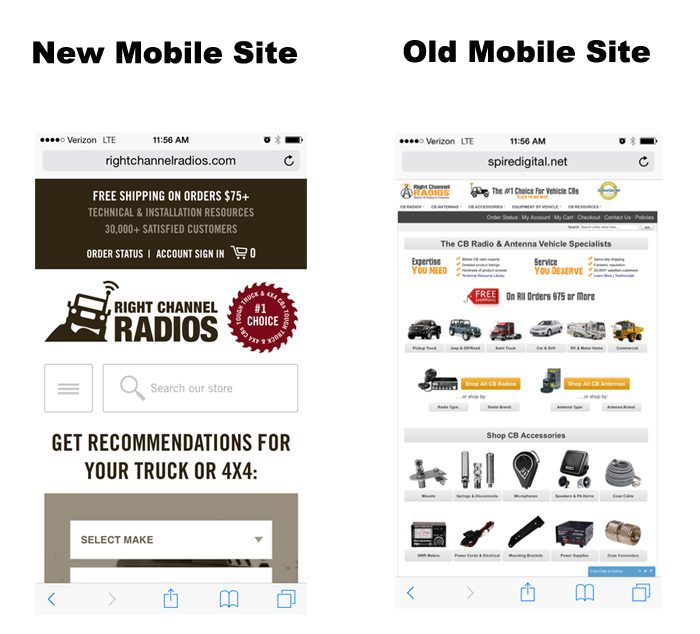
You can get a sense of the difference from old to new mobile experiences in the picture below. The old mobile experience was just a rendering of our desktop site on a small screen, which was terrible from a usability perspective. The new version is much larger and better optimized for less screen real estate:
Improving the Mobile Checkout
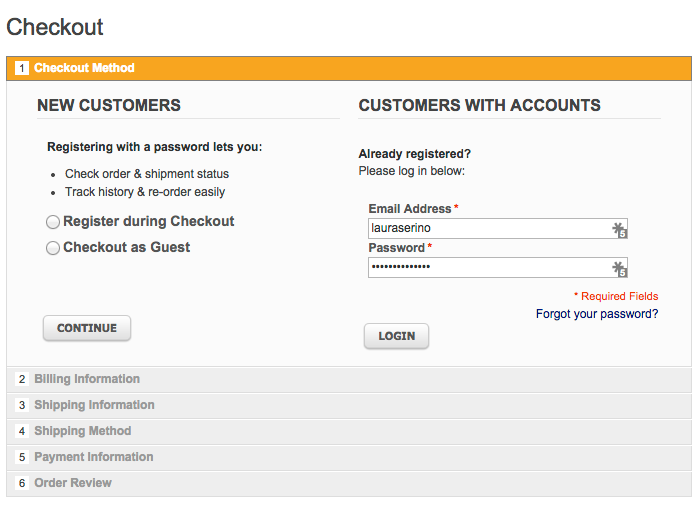
The checkout we had been using was the stock Magento checkout flow. While it wasn’t terrible, it was by no means great. The biggest problem was a confusing screen that all customers faced about logging in, continuing as a guest or creating an account.
Sometimes it took me a few seconds to figure out what the obvious next step was, and it was my store! I know it was often confusing for customers. You can see what it looked like below:
The Old Checkout Page
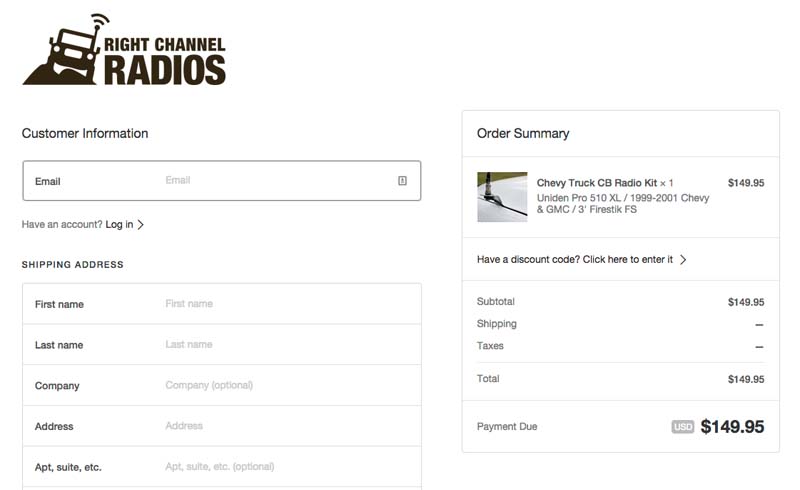
About half way through our redesign, Shopify rolled out their new responsive checkout. Apart from being mobile optimized, it solved a lot of the pain points I had with our Magento flow. A few of the things I specifically appreciated about it:
- It asks for an email address as field #1 to increase the number of people you can send abandon cart emails to
- It doesn’t ask customers to create an account until AFTER they complete their purchase
- It boasts a very clean and straightforward one page checkout that pre-fills in the city and state based on IP address
Very cool stuff. You can see what the desktop version of the checkout looks like below.
The New Checkout Page
The desktop checkout improvements are great, but where I think it had the most impact was on mobile.
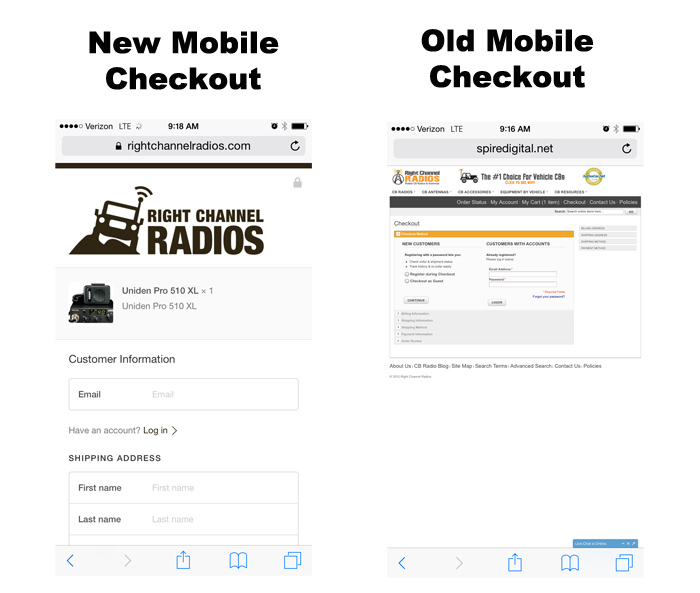
Entering personal and payment details is one of the biggest reasons why mobile conversion rates are usually much lower than desktop. It’s a pain to enter all of that information via a small keyboard. Combine that with our legacy clunky, non-mobile optimized checkout and you’ve compounded the problem.
The new responsive checkout solved both of those problems, and has made mobile checkout much simpler. You can see the difference below:
The Impact on Mobile Conversion
I’ll wait to share the final redesign results until the end, but I can’t resist sharing a teaser. The changes above were responsible for mobile conversions increasing by a whopping 110%. That’s more than a doubling of the sales from people shopping on their phones. Tablet conversion saw a boost as well, although not as large, coming in at a 24% increase.
Doubling the conversion rate for our largest traffic source? I was pretty excited about that.
Usability Improvements
As I wrote in my post on preparing for a redesign, we did a lot of user testing prior to the design phase. Specifically, we were trying to discover where customers were having problems and pro-actively address those in the new site. Here are a few of the changes we implemented based on that research.
Vehicle Recommendation Wizard
One of the biggest pieces of feedback we received was that users wanted a place to enter their vehicle information and get customized recommendations. This is a pretty common thing in the automative parts industry, but something we’d surprisingly never thought of. So it become a primary part of the redesign.
Leveraging Carson’s team’s expertise and Shopify’s customizable framework, we created a recommendation wizard and placed it front-and-center on the homepage, as you can see below. Now it’s easy for customers to get customized recommendations for their specific make and model vehicle, something we traditionally had been doing manually via phone and email:
The Vehicle Wizard Page

Wizard Results Page
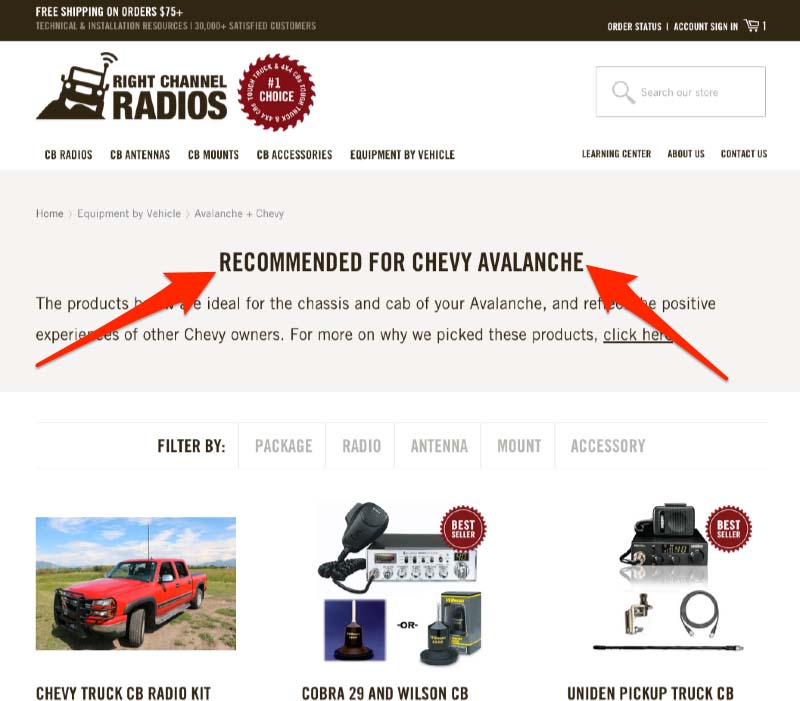
Category Pages
Our old category and product pages had a lot of information, but were hard to digest without reading paragraphs of tiny text. Definitely not the best approach for helping busy, impatient visitors quickly find what they’re looking for.
Our old category and product pages had a lot of information, but were hard to digest…”
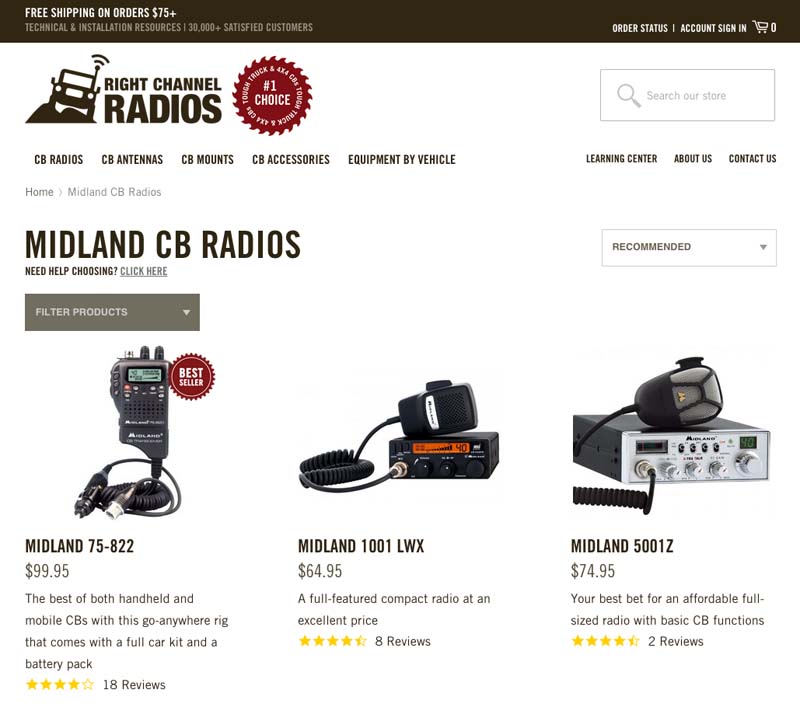
So we redesigned both with an emphasis on simplicity & the ability to easily scan them. Our new category pages replaced paragraphs of descriptive product text with a single sentence highlighting the top strength of each product. We switched to a grid format to show more products on each page. And we added “Best Seller” badges to help point shoppers to the most popular products.
You can see the difference between the old and new pages below:
Old Category Pages

New Category Pages
Product Pages
We followed a similar approach with our product pages in terms of making them simpler and easier to digest. Pictured below is one of our old product pages, filled with information but not what I’d call digestible.
Old Product Page

To make the new product pages cleaner and easier to scan, we did the following:
- Put 1-3 bullets at the top of the page to quickly convey each product’s key selling points
- Increased the text size for easier, no-squint reading
- Placed videos front-and-center in the image placeholder box by default. (Are replaced by images when thumbnails are clicked.)
- Increased the size and prominence of the “Add to Cart” button
- Added buying considerations (free shipping, technical help, etc) as checkmarks next to the “Add to Cart” button
- Wrote story based, emotionally driven & cheeky copy and placed it above the nitty-gritty tech details. The drier product specs are listed further down the page for people who really want to dive into them.
You can see our incorporation of all these concepts below in the new version of the product page:
New Product Page

A “Smart” Geo Detecting Shipping Calculator
One of the things I’m proudest of is the shipping calculator Carson’s team built for the new site. If you’re a store owner, you’re almost certainly aware that uncertainty around shipping costs is one of the largest reasons people abandon carts. So having a shipping cost calculator is important.
But most calculators have two flaws: 1) they make the customer manually enter their location and 2) they don’t sufficiently answer the question of when a package will arrive.
Most shipping calculators have two flaws: 1) they make customers manually enter their location and 2) they don’t specify a delivery date”
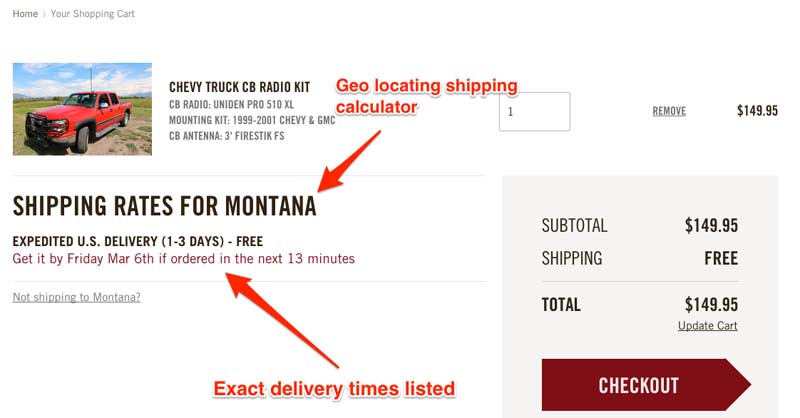
We wanted a shipping calculator that solved both those issues. Our new shipping calculator uses your IP address to figure out where you are geographically, and automatically displays the shipping options to your location without any manual user input.
It also gives a concrete date to expect delivery by. So instead of offering 1 to 5 day shipping (as we had previously been doing), customers can order confident in the knowledge that they’ll “Get it by March 15th”, making it easier to pull the trigger on time sensitive purchases. This is something Amazon does really well, and is actually the inspiration for our calculator.
You can see the calculator in action below:
Our Geo-Locating Shipping Calculator
“Help Me Choose” Buttons for Product Options
Another friction point with users was indecision and apprehension when it came time to pick options for a product or package.
A visitor would be ready to add something to their cart, but then realize they had to make one or a series of decisions in terms of selecting product options. We had all of the information detailing how to decide between different product options further down on the page, but customers rarely went looking for it. Instead, they usually froze up and abandoned the purchase process.
No bueno.
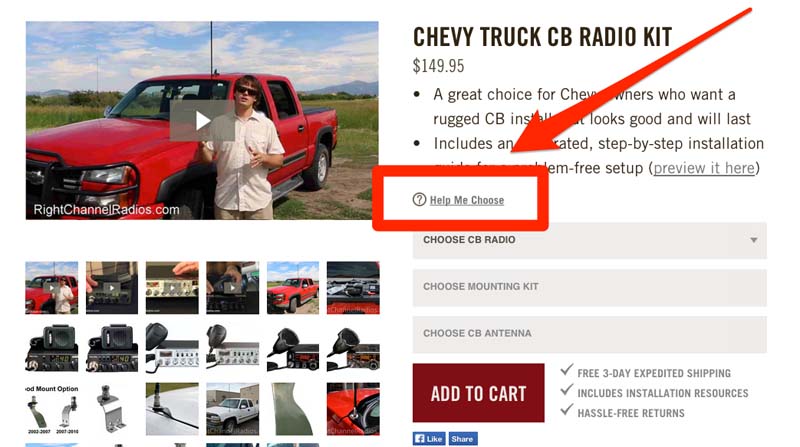
To address this problem, we created a “Help Me Choose” icon and placed it right above product drop down options. When clicked, it brings up a lightbox that contains information specifically to help the customer picking the right product options so they don’t need to go digging further down the page.
Pro-Actively Helping Customers Configure Products
Switching to Shopify from Magento
 There are many great shopping cart platforms out there. As I mentioned in my original post about the redesign, we’ve been on Magento Community Edition for 3+ years and over that period I’ve realized it’s not the best fit for our eCommerce company.
It’s hard to administer, so you either need to know your way around a server or hire someone who does. It’s difficult to customize, and ever more frustrating to upgrade. And it’s a massive resource hog.
Ultimately, I got tired of having to play system admin when all I wanted was a stable shopping cart that worked well, was easy to customize, and would automatically stay up to date.
Enter Shopify. I’ve always been impressed with their platform, but now more than a month using it to run our store I can definitely say it was an excellent move. Here are just a few of the things I’m loving:
No More Tech Worries
To get up-to-speed with Magento, I literally spent the better part of a month teaching myself UNIX and learning about the template structure. Even then, I still never got fully comfortable and issues would pop up every 3-4 months where I’d need to spend hours researching and implementing a fix.
No more. Since it’s a hosted solution, Shopify manages all of the server, upgrade and code maintenance issues. I can’t wait to cancel my old, expensive Rackspace account where we hosted Magento and wash my hands completely of server and security maintenance.
Hosted, But Extremely Customizable
The biggest argument against using a hosted cart solution like Shopify is control. With any type of hosted solution, you don’t have access to the underlying code and aren’t able to fully customize it to your needs. And this is true: with Shopify you don’t have true 100% control.
But I’ve yet to run into any real roadblocks in terms of things we couldn’t customize on Shopify with their impressive template engine and API. Our geo-locating shipping calculator and custom vehicle recommendation wizard – both fairly complex features – were both implemented within their hosted environment. Pretty impressive.
Ease of Extensibility
On Magento, I was terrified to let anyone but myself install extensions. Occasionally there’d be an extension incompatibility that wouldn’t work properly or bring down the site – so I didn’t trust anyone but myself to do it. This made it harder for me to delegate and for my team to pro-actively run with implementing new features and functionality.
With Shopify, adding extensions is incredibly easy. A couple of clicks and you’re done, and I haven’t run into any incompatibility or stability issues.
Simple & Intuitive Interface
While not terrible, the Magento admin interface is not what I’d consider intuitive. Issuing a customer refund, for example, would require clicking through 2-3 screens to find a related billing invoice and using THAT to issue the refund. Comparing Shopify vs. Magento, you simply click “Refund” right on the order page.
It’s been so intuitive that our team was able to hit the ground running on day one with almost no training. With Magento, we literally had half a dozen SOPs related to how to cancel/edit/refund orders because the process could be murky. Not an issue with Shopify.
And a Number of Other Things
There are a number of other things I appreciate as well. Support has been solid, server response time is good, enhanced eCommerce analytics support for Google Analytics in built-in and Shopify Payments integration is really nice from a fraud detection perspective.
While I’m sure we’ll run into some minor quirks at some point (as with any platform), I’ve been really happy so far with Shopify and definitely have no regrets making the move from Magento.
The Results
Enough talk already! What did all these sweeping changes do to our bottom line?
To calculate the results, I compared the conversion rate on our old site in January to the figures for our new site in February. To ensure no seasonal bias, I compared the difference in conversion rates between Jan and Feb conversion rates in 2014 and adjusted accordingly. Here are the results:
-
- Change in Overall Site Conversion: Improved by 41%
-
- Improvements by Device:
-
- Mobile Conversion: Improved by 110%
- Desktop Conversion: Improved by 25%
- Tablet Conversion: Improved by 24%
While we didn’t quite hit my aggressive goal of a 50% conversion increase, it’s hard to be disappointed with a 41% conversion lift across the board. I’m also optimistic that many of the long term brand investments we made will pay off over time to move us closer to – or even above – that 50% improvement.
One caveat to these numbers: Traditionally, orders via phone haven’t been a meaningful part of our sales and we traditionally haven’t publicly posted a phone number. For the first month post-launch, we did make our number more visible to ensure we could quickly find out about any site problems or usability issues.
Based on our analytics, about 4.5% of our orders came in via phone and I’d guess about half of those – roughly 2% – might not have been placed without our phone as prominently displayed. So not an enormous number, but worth mentioning in the sake of full transparency.
Hiccups and Problems
I was thrilled with the overall results, but like any project of this size there were plenty of hiccups along the way. Here are a few of the issues and/or problems we’ve run into:
Decrease in Avg. Order Size
Our average order size decreased approximately 4% with the new site. This was especially surprising given that the “Add to Cart” flow we created emphasized related products, which we thought would increase the overall order size.
Our average order size is often highly skewed with large orders than can come in once or twice per month (or not at all), so hopefully this is just an off-month and not a long term trend. We’ll be keeping an eye on it, as well as potentially split testing our “Add to Cart” flow in the future to see if we can turn this around.
Massive Drop in Pageviews per Visitor
Average pageviews per visitor plummeted by a shocking 45% with the rollout of the new site, and I can’t definitely say why.
Average pageviews per visitor plummeted by a shocking 45% and I can’t definitely say why.”
One potential theory: our old Magento site fired up a new window/page whenever people tried to view an image while our Shopify store doesn’t do that. This could perhaps explain the difference.
A decrease in pageviews isn’t always bad if you’re simply helping customers find products faster and more efficiently. But it still a slightly troubling shift, and one I’ll be diving more into.
Botched Order History Migrations
I’ve always used the service Cart-2-Cart for migrating customers and order histories without incident. But sadly, this migration didn’t go quite as smoothly.
Our customer order records were transferred properly from Magento to Shopify except for the order date. Instead of showing the actual order date, what was recorded was the date the order was imported to Shopify. So all our past orders now appear as occurring on the 9th of January, 2015. Not good.
Along the same lines, Cart-2-Cart didn’t transfer data related to whether a customer from Magento had an account or simply checked out as a guest. Instead, all customers were imported as having no account so we had no idea who to create accounts for and who didn’t historically have one.
Fortunately, Shopify deals with orders, customers and accounts in a very forward thinking manner by linking everything to an email address. So we were able to create workarounds to allow customers to create a new account and auto-import their old order history. But between the botched order dates and run-around for account creation, I wasn’t as impressed with Cart-2-Cart as I have been in the past.
You can read more about how not to botch your website migration with our in-depth migration guide.
Impact on SEO / Organic Traffic
One of the biggest concerns people have when migrating platforms is losing their SEO rankings if/when URLs change. Shopify uses a different URL structure than Magento, so taking a hit on the SEO front was definitely a major risk factor for our migration. Fortunately, we haven’t yet (knock on wood) seen any major impacts to organic traffic from the change to our URLs along with the corresponding 301 redirects.
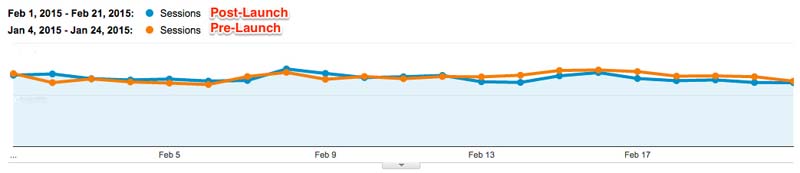
Traditionally in past migrations, I’ve seen a 10% to 15% decrease in organic traffic for a 2-6 month window post-migration. Other private forum members have experienced similar decreases as we discuss in this thread on the topic. You can see the change in organic traffic from January compared to February below. There was a small 2%ish change, but nothing significant.
Change to Organic Traffic Post-Launch
We used the Traffic Control App to manage our redirects and I was pretty impressed with it. The app definitely makes for a nicer, more organized and efficient process than manually creating 301 redirects via .htaccss files which is what I’ve done in the past.
We also started using Yotpo as our product review service, which includes rich snippets integration on Shopify’s product pages. I’m not sure exactly why, but once we moved over to Shopify/Yotpo nearly all our product pages starting displaying in the SERPs with rich snippets when in the past they almost never did.
So perhaps we did / are seeing a slight decrease in organic rankings, but one that’s been offset by a higher click through rate due to the increased number of rich snippets listings. It’s really hard, if not impossible, to tell. I’m just thankful that we managed the migration so far without any major SEO snafus.

Am I Glad We Did This?
Ultimately, we spent six months and $50,000 on a redesign that didn’t increase sales quite as much as I was hoping for. So am I glad we did it?
Absolutely.
While the 41% conversion boost wasn’t quite the aggressive 50% jump I was hoping for, it’s still an enormous boost to the business. Our payback period on our investment will be under a year, and that’s just considering the increase in net income. If you look at increased value of the business itself – that is, the increased amount I’d be able to sell the business for based on increase earnings – the investment has already paid off numerous times over.
The value on the branding front is hard to measure, but I’m confident our new site, message and approach will build up our name recognition and reputation over time. Ultimately, this will lead to increased trust and sales in the long run.
And finally, with mobile growth showing no signs of slowing down, having a site that’s optimized to capitalize on that trend is enormously beneficial. Instead of fearing the surge in mobile users we’re now in a position where we can benefit from it. When Apple Pay or some other technology makes mobile transactions much easier (and it will, eventually), we’ll be ready to further take advantage of our highly optimized site.
Playing Devil’s Advocate
To play devil’s advocate for a moment, there are a few downsides to my decision and approach. First, you could argue that I could have implemented a mobile friendly approach for significantly less money by simply installing a $250 mobile theme on my existing Magento store. Perhaps this would have resulted in a lions share of the gains we experienced for – literally – less than 1% of the price.
I gave up having micro-level insights in order to more efficiently transform the website and brand into what I wanted it to be.”
It’s definitely a valid argument, and thinking back it would have been a good first step to try. But ultimately, that approach would have been a short-term solution to a longer term problem.
It wouldn’t have addressed the other core problems we faced in terms of our desire to improve our branding, switch platforms and re-think our design. And I can absolutely guarantee that a stock mobile template wouldn’t have been nearly as good as the one that was customized exclusively for our site.
Looking back, perhaps we could have taken a more incremental approach to see what worked and what didn’t. But incremental approaches also take more time. You can be more sure of an outcome, but it’s harder to make large, sweeping changes quickly.
I gave up having micro-level insights in order to more efficiently transform the website and brand into what I wanted it to be. Ultimately, at least this time, it all worked out in the end.
The Team That Made This Possible
There’s absolutely no way our new site would exist today without the help of an entire cast of people.
Carson McComas and his team at Shopify Custom did an absolutely incredible job of turning our vision into a website we’re really proud to call our own. It’s hands-down the best contractor working experience I’ve ever had and I can’t say enough good things about his company. If you need quality Shopify work, I’m not sure if there’s anyone better out there. Thank you Carson, Jacob and Jennifer – you guys are amazing!
My team at Right Channel Radios and eCommerceFuel were also absolutely instrumental in getting this site launched. Thanks to Pat Haggerty for his work producing awesome video content and with product and customer migration. To Laura Serino for all her incredible work spicing up our copy as well as proofreading the site. And thanks to both Kay and Sheral for their help with a myriad of migration related tasks. Thanks, guys! I’m a lucky man to get to work with you each and every week.
Thanks to Ed Hallen from Klaviyo, Talia Shani from Yotpo and both of their teams for providing in-depth technical support with the migration. For email marketing and product review software, I can wholeheartedly recommend both Klaviyo and Yotpo as top-notch solutions.
And finally, thanks to the team at Shopify for their support both in the early stages of this transition as well with the nitty-gritty technical details of launching the site. To Mark Hayes, Emma Craig and numerous Support Ninjas: you guys do an incredible job, and have built an incredible eCommerce platform to be proud of.
And thank you, dear reader, for making it to the end of such a monstrosity of a post! Hopefully you were able to take a way a few nuggets. As always, I’m more than happy to answer any questions about Magento vs Shopify or the migration in general in the comments below.
Love eCommerce Case Studies Like This?
If you enjoyed this write-up, you’ll go crazy in our private forums where 1,00+ vetted independent store owners & experts connect to share tips, tricks and advice from their real-world businesses. You can learn more and apply here.
Photo by Heather Weaver.

Post by Andrew Youderian
Andrew is the founder of eCommerceFuel and has been building eCommerce businesses ever since gleefully leaving the corporate world in 2008. Join him and 1,000+ vetted 7- and 8-figure store owners inside the
eCommerceFuel Community.

120 Comments
Hi Andrew,
Nice job and great recap of the process! I love the clean and refreshing look of your new site and was curious which template you ended up using. I know you did lots of customization but if I recall correctly you started with a base template from the theme store right?
Thanks!
Josh
I am curious. Did you guys ever evaluate BigCommerce while you were in the process of evaluating Shopify? Of so, I would love to know why you decided to not go that route.
We did! I actually did an in-depth write up comparing the two, where I discuss why I ultimately think Shopify is a better platform. You can read that here:
https://old.ecommercefuel.com/shopify-vs-bigcommerce/
Hi Andrew, I really like the new site design! Did you use a base theme in Shopify and then have it customized or was it built from scratch? If you used a base theme, can you share which one? We need to redesign, as well, and your new site has definitely provided some inspiration, thank you!
Thanks Tiffany! Our designer Carson worked from the Timber theme (linked to below), but it’s a fairly customized version they use to start most of their stores that provides a really flexible framework.
http://shopify.github.io/Timber/
Great read. I have to agree Magento is a beast. I’m really surprised with the amount of $$ you put into everything that you didn’t simply hire a pair of developers to build you a custom shop.
I can see where you guys are coming from. Magento is a beast, but being a techie, so I can manage darn near everything myself. I do agree it is more involved than Shopify from just glancing at a demo Shopify store. And although I’m a techie I see the merits that the ease of use Shopify seems to offer.
that said, I think I’m stuck with Magento at the moment. Had I know of Shopify when I started I would have gone with that.
[…] reasons why I think this is a little bit of a vanity metric, really not that important, is when we relaunched the new Right Channel Radios website going from Magento to Shopify, we hit about a 41% conversion increase. But our page views fell off a cliff by almost half. I […]
[…] If done right, the migration can improve your sales by a huge factor. Get inspired by the story of how Right Channel Radios improved their on-site conversion by 41%. The conversion from their mobile site went up by 110%! Read the full case study here: Migrating to Shopify from Magento: The Results of our $50,000 Redesign […]
I would say that Magento is a nice platform for designing a website. But today, Shopify has given far better features in their services with which an ecommerce website can be designed easily. Good to go with. Nice info
[…] week Dan is on vacation in Asia with his family, so I’ve invited Andrew Youderian of eCommerceFuel onto the show to talk about what it means to be a bootstrapper and the differences between a […]
Awesome post! Thanks so much for sharing. I loved the podcast on this one and the personal note on the confirmation page is stellar. I appreciate you reading it on the podcast. The new website design is GORGEOUS!!!!!!! Glad to hear conversion rates are up so high, but certainly not surprised. The new design is killer.
Hi Andrew,
Great writing. Your experience with both of the platforms are seems good. Your new web design is awesome specially the colors and i like it. Shopify is great but Magento services are also good.
Yae. That’s a great comparison her for magento and shopify. But the price seems to high for the conversion. I am new to the ecommerce field. And I heard about duceplus.com and its benefits. Shall I look for the service apart from magento and shopify. Is that more reliable.. Can anyone could explain me.?
Well it presents some insights into how well you have designed your new website.
However, I think none of the points truly present a picture of comparison between Shopify vs. Magento.
Your post’s heading tells we are going to read about shortcomings of Magento and advantages of using Shopify.
There are none presented in this article.
Whatever has been done on the new website can be done using Magento as well.
New home page design..? very much possible using any cart, not just Magento or Shopify.
New Logo..? Not relevant when we are talking about comparison between carts.
Responsive design..? again not relevant when we are comparing carts.
Nice to see that your business is gaining because of new website, but please do not hold Magento responsible if you faced any issues in past.
Regards,
Divakar
Agreed, the only insight that can be taken from this article is non-technical people will benefit from a hosted solution which is an obvious point to make.
You changed too many variables to attribute any change in conversion to a particular platform. If you wanted a true comparison you should have designed your shopify store with the exact same design and feature set or better still, split test both platforms for a month.
Thanks Divakar & Nate for the great points. I was thinking the same, and being the owner of a Magento store, I was a bit disappointed in the article. It didn’t help me all that much as I am considering converting to Shopify. I am a techie, so Magento isn’t that hard for me to manage.
Some of the things I am interested in knowing is how the shipping calculations work in shopify since that is an area I feel Magento is a bit lacking. I also like the idea of a fast hosted solution with SSL already built in. All the redesign stuff can be done on any platform.
I think perhaps, I may split test a Shopify store replicated from my Magento store and see what the main differences really are.
Hi, Andrew! Thanks for sharing this amazing experience! Personally I prefer Shopify to any other CMSs, to Magento also. That’s why, it’s quite interesting for me to read this review. As well I appreciate all your eCommerce reviews I ‘ve read before greatly, I’ve got so much helpful information for my eCommerce research.
Hi Andrew,
Excellent article. Can’t imagine how much time this took you to put together. It is very kind & generous of you to share like this.
I was already pretty set on it but now I’m even more certain that Shopify is perfect choice for my small business needs.
Also agreed cheeky copy is the best for these and many customers like ours as well.
Liking the new look.
Super Video too.
Last thing please.
What’s are the best articles you have read about social media and getting it all organized & done correctly to promote your company the right way?
Including which app would make it easiest as well for Shopify?
I was reading about HootSuite for example as the top app for Shopify. Seems like a great choice for organizing everything all in one place. Are you using it already for your site?
Thanks for sharing everything & warmest regards from Thailand,
Matt
P.S. The Website will be up once we get Shopify up and running.
Really interesting, in-depth post.
Here’s another Shopify vs Magento piece I thought was pretty good: http://www.underwaterpistol.com/blog/shopify-vs-magento-which-should-you-choose
Sonny, I used to use Prestashop also and although I moved to Magento it will always have a special place in my heart. Great platform and great community!
Well explained article! Magento and Shopify have their own best features! Magento is a free, open-source platform to develop large e-commerce websites whereas Shopify is commercial CMS. Magento platform is designed for larger websites whereas Shopify is best platform for small sized e-commerce businesses
[…] Equipped with that knowledge, we made the design to invest heavily in a new mobile redesign which ultimately helped us double our mobile conversion rate. […]
[…] Andrew Youderian, the founder of the insanely helpful Ecommerce community Ecommerce Fuel recently completed a $50k migration of his online shop Right Channel Radios from Magento to Shopify. […]
[…] For example, with the Right Channel Radio redesign, we’ll link up over to that, of course. I think a lot people are familiar with it, with […]
Thanks Andrew – quality info post.
Q: What in your mind is the base sales channels (Facbook/. YouTube) to promote products on? Also, whats your view on paid versus organic SEO or social media?
I would like to know, what product/service do you want to promote?
Thanks,
Dan Lewis
$50k is a lot of money and I too would expect an increase with any eCommerce effort, but I think completely overlooking and not implementing at the very least a responsive theme on your Magento platform before migrating makes me scratch my head. The complexity of your catalog screams Magento. I was on your site a few days ago, and couldn’t believe my eyes when I looked at the source code. What a migration! Looks wonderful!
The article heading is very misleading. Producing a polished website optimized for the website’s user base could have been accomplished using magento, and would likely have seen the same net increase. Further, the additional costs for companies not sponsored to make the switch have not been taken into account. This article is more “Why Creating A Strong Online Presence Is Important For E-Commerce Sites”, and less “Migrating To Shopify Will Increase Returns”.
Disclaimer: I do not use shopify or magento.
Hey Andrew,
Instead of migrating the platform, you should have tried a Magento responsive theme. Some of the best responsive themes are available for around $100.
You would have been able to customize the theme to any extent you required. Having thousands of extension will certainly have a risk of running down into the wrong one. But that needs to be taken care of. As a developer, we don’t add features directly on LIVE we always have a staging env.
I don’t see any extraordinary features which shopify offers that are absent with Magento. To be frank $50K for just a redesign is not what I would have considered spending.
This article is misleading. The old site you have looks like an old version of magneto. You are comparing an old mageneto site with a new shopify framework, that’s not an even comparison. If you directed more money to the SEO and just upgraded your magneto to a responsive framework you probably would be 40k better off with a site that you actually own. Shopify does not bring in more customers. A descent campaign does. And my experience with shopify is that there are always quirks with the responsiveness. It works but i dont think its that great. Its so obvious most of the time that its a cookie cutter site. You have complete control on an opensource platform. You have supercharged SEO tools at your disposal which are cutting edge. You own your data. You can move your shop. You can make it ultra fast. You can change your template. I have developed sites for over 15 years and I am not aligned commercially to any platform.
Hi Ray,
I developed sites on Magento (Community and Enterprise) and also Shopify. For me Shopify is just for Amature business persons, who dose not have big requirements and also does have enough funds to build a Web Team. Just to make your web-present, even without any technical guy, anyone can build a site on Shopify. But if you need to think your business seriously, the you have to move with any of the Big E-Commerce platform and that wont be Cookie-Sharing.
Thanks,
Dan Lewis
Have been driving traffic by pop-under on one of my sites from a newcomer network http://ads1k.com/ and some days are better than the others. Anyone has any idea on how to improve the visitors flow?
For those who are not here yet, pop-under opens your pages on somebody else ‘s site.
Hey Andrew,
At first its really a nice article. I am developing and maintaining both Magento and Shopify sites for my clients. I do trust on Shopify platform, when you have less product and simple category structure. But when you have 100K products with n level of category structure and also SEO friendly structured URL, sorry to say, but Shopify not really ready for that!! You explained about designing, ohh, its a very simple task for a Magento Web Designer to make the deign as you need, even that will be in your control. You can change any page as you want, even you can show two separate content for Web and Mobile users. However, in Shopify, you dont have the power to change anything after the Cart page. Even the complex category structure not working Shopify site.
The most important aspect is, what is your business requirement? If you just want to make a simple web-present, then Shopify is best for you, but if you seriously want to think about your Business and if you have future Plan for that, then definitely Magento is your Choice. You can do anything with this monster. Its all yours!!
Nevertheless, its a nice article and I enjoyed reading.
Thanks,
Dan Lewis
[…] where a number of others have expressed similar feelings. In fact, the founder of the site moved from Magento to Shopify (at a cost of over $50,000), and seemingly has no regrets. He runs convincingly honest ads on his […]
While I agree that Magento has a huge learning curve, I’d like to point out that switching frameworks has nothing at all to do with the design of your site.
I’ve developed many, many magento sites that are both responsive and mobile friendly all around (emails, admin section, etc).
It also looks like you used stock checkout in magento, which is terrible anyways. There are other checkout solutions that cost no more than 300 dollars as well, if you don’t go the custom development route.
I just hate to see anyone make a rash decision with their ecommerce store, based solely on a theme and branding upgrade 🙂
Interesting. But I am still not sure why Shopfiy. If you invested 50,000$, I believe you could have done the same on Magento or Prestashop or WooCommerce. It would have cost less (as other have pointed out as well).
Apart from the conversions, what other benefits have you noticed about Shopify?