
 Andrew Youderian
•
April 29, 2013
Andrew Youderian
•
April 29, 2013
The SEO Mistake That Wiped Out 80% of My Traffic
It was just over a year ago that one of my sites lost nearly 80% of its organic web traffic due to Google’s now-infamous Penguin update. As much as I wanted to blame Google, sadly I was the one responsible for my misfortune.
What SEO mistakes did I make? And how can you prevent this from happening to your business?
Some Background
As many of you know, I started my first eCommerce business, Right Channel Radios, in 2008. As a solo founder with an eye on expenses, I bootstrapped everything myself, including SEO. I reached out to blogs, wrote articles and built personal relationships. In short, I invested a lot of time connecting with others, guest posting and creating valuable resources. And it worked! Within a year, I’d built a solid reputation, and the business was growing largely due to organic traffic.
With some traction under my belt, I decided to launch my second site, TrollingMotors.net. I figured I could use the cash flow from Right Channel to grow my new site quickly by outsourcing much of the SEO. So I hired an SEO firm to improve my rankings, thinking it would free me up to focus on other aspects of the business. No need for me to get down-and-dirty with all this difficult work to increase my organic traffic! This time I was going to take it easy.
I had good intentions to monitor the firm’s progress, but as time went on, I didn’t follow through. I was busy with other aspects of my businesses, and because I knew the SEO firm’s owner, I assumed things were being handled well.
Then last April I was checking my rankings in Google when I noticed I’d slipped from #2 to #10 for ‘trolling motors.’ Figuring it was just a temporary adjustment or data center issue, I checked my site analytics. Horrified, I discovered that the site’s organic traffic had dropped 80% over the last few days. After some frantic research, I realized what had caused it: Google’s Penguin algorithm update, which targeted over-optimized sites and backlink profiles:
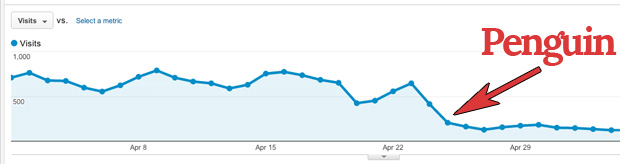
Some long-overdue analysis revealed a trail of over-optimized links, with one page having 14 of the 15 linking domains using similar anchor text. And while I knew the SEO firm hadn’t used 100% squeaky-clean link techniques, I unearthed strategies and links that were downright spammy and embarrassing. It was amazing I hadn’t been penalized earlier.
Not surprisingly, the Penguin update didn’t negatively affect the traffic for Right Channel, my business where I’d done all the SEO and marketing work myself. If anything, I even saw a small boost in traffic as a result.
So what did I learn thanks to Penguin and my outsourcing debacle?
Be Very Careful Outsourcing SEO
I’m sure this is a no-brainer to most people, but sometimes you need to learn lessons the hard way. When you outsource your SEO, you’re trusting someone with the future of your business; it’s imperative you monitor them closely. This is even more important if you drop ship! Due to the smaller margins, it’s much more difficult to build a profitable drop shipping business with paid traffic versus free organic traffic.
It was easy to justify my lax oversight with the fact that I had a personal relationship with the firm’s owner, and I knew he was using the same methods to generate traffic for his own businesses. Big mistake. Had I been monitoring things closely, I likely would have been able to catch and correct many of the over-optimization issues that occurred.
But even assuming you’re committed to careful monitoring, outsourcing causes you to miss out on crucial feedback. Engaging with people during marketing gives you the opportunity to learn about their problems, issues and pain points. In turn, this allows you to offer better solutions and products, and helps build your knowledge and expertise. You miss out on all of this when you outsource SEO, especially when launching a new business.
So be warned and learn from my mistake! Outsourcing can seem like a great way to get additional traction with your SEO and marketing efforts, but it comes with strings attached.
The best marketing and SEO is done by a committed in-house team that builds real relationships with others in their niche. And if you’re marketing your first site, I strongly recommend doing your own SEO and marketing to learn the ropes and build your experience. If you ever do decide to outsource it in the future – or hire your own in-house team – having the knowledge from doing it yourself will be crucial to properly manage the process.
At the very least, if you do outsource, make sure you keep a close watch on the processes and results.
Diversify Your Traffic
While the pain caused by the Penguin update was ultimately self-inflicted by my poor oversight, it drove home how risky it is to rely on Google for the majority of my customers:
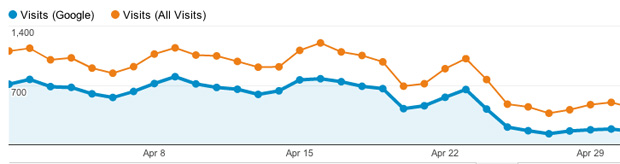
When you play by the rules, Google is obviously a (well, THE) best source of ongoing traffic you’re likely to find. But my run-in with Penguin made me realize how crucial it is to invest in other sources of inbound traffic so my businesses don’t rely primarily on Google. Here’s how I’m planning to diversify my traffic stream:
Utilizing Email Marketing
Despite having a great database of customers, I never made email marketing a priority. A quality email list/newsletter offers the ability to drive traffic on demand. As I highlighted in my previous post, we’re ramping up our email marketing efforts for 2013 and will be sharing the results on a quarterly basis.
Investing in Building a Brand
Just last weekend I was talking with an SEO expert about how building a brand is the only way to have guaranteed long-term success with eCommerce. People visit websites. They talk about, recommend and are loyal to brands. And the more well-known your brand, the more likely people will actively seek you, generating traffic that’s not dependent on Google.
Going forward, we’ll be sponsoring more events, giving away stickers, holding contests and continuing to focus on great customer service in order to improve our brand recognition. “Brand building” can sound like hokey marketing jargon, but the KISSMetrics blog just wrote a great article on the power of brands and how to build your own.
Focusing on SEO That Drives Direct Traffic
Pursuing strategies that emphasize traffic in addition to link juice is a great way to improve visits and to diversify against Google. I’ll be focusing on SEO opportunities that generate traffic AND link juice.
A Few Penalty Insights
Although this post is mainly about the broader lessons I’ve learned, I want to share some technical data points regarding a few keywords that were hit hard and others that weren’t affected as severely. Be warned: Geeky SEO talk ahead. 🙂
The chart below lists keywords that were affected by Penguin and are grouped by how severely their rankings were hit. The “On-Page Fix Improvement” column refers to how the keyword rankings changed after I un-optimized the page for a given keyword. “Anchor” refers to the anchor text in the links pointing to the page a keyword ranked for.
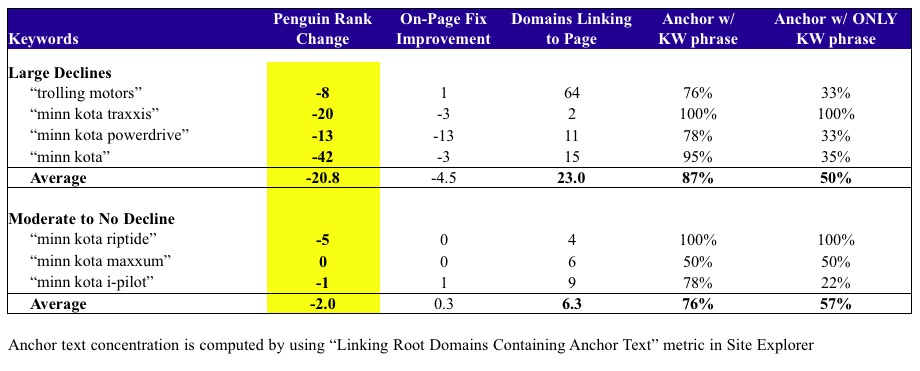
Please note that this is a VERY small sample size, so these conclusions are by no means scientifically provable. But that won’t prevent me from hypothesizing about a few things anyway. 🙂
Penalties Focus on Off-Page Issues
After reviewing the pages that were hit the hardest, I realized that my on-page SEO reeked of over-optimization. My keyword phrases appeared far too often on-page, and far too prominently, so I quickly made changes to address the problems.
Unfortunately, this didn’t solve the issue and resulted in many further declines (refer to the ‘On-Page Fix Improvement’ column). You could make the assumption that the Penguin penalty isn’t primarily an on-page one, as de-emphasizing my on-page SEO only made things worse. Over-optimized anchor text, it could be argued, seems to be the primary culprit.
This hypothesis is a bit weaker than the others, as many believe the Penguin penalty only updates/corrects occasionally, instead of on a daily or weekly basis like Google’s overall algorithm. So it’s very posible that the de-optimization changes could have helped if I’d left them alone long enough to be recognized by a Penguin update. That being said, from all the other research I’ve done, it appears that over-optimized anchor text is one of – if not the – biggest triggers of the Penguin penalty.
Penalties More Aggressively Applied to Popular Pages
One hundred percent of the anchor text for my “minn kota riptide” page was “minn kota riptide,” which you’d expect to trigger a penalty. And it did – the ranking page dropped five spots, from #1 to #6.
But it didn’t drop nearly as much as our page ranking for “minn kota.” Despite having anchor density that was less concentrated than the “minn kota riptide” page, the “minn kota” page dropped 42 spots, falling from #7 to #49. Ouch. The most noticeable difference? The number of unique linking domains: 4 to the “minn kota riptide” page and 15 to the “minn kota” page.
It’s likely that Penguin penalties are more aggressively applied for pages with more incoming links. If two domains link to a page with the same anchor text, it doesn’t necessarily imply over-optimization. But if 150 out of 300 do, an orchestrated SEO campaign is much more likely.
If you’re trying to recover from Penguin, it may make sense to start with your best ranking pages with the fewest number of incoming links. You may need just a few new anchor text variations to lift the penalty and restore your rankings.
Recovery and the Lasting Impacts

One of the most painful aspects of irresponsibly outsourcing your SEO is the massive mess you’re left to clean up. Trying to scrub lots of spammy and over-optimized links is a daunting, confusing and involved process. While I won’t be offering a detailed description of how to do this in this post, there are a number of great pieces on Penguin recovery, including this one on the SEOMoz blog.
Over the last year, we’ve contacted site owners in attempts to have links removed. We’ve re-examined the optimization on many pages including keyword usage in product descriptions and category descriptions. We also removed keyword-optimized footer links from the site. We’ve also built a number of new high-authority links in an effort to boost our authority with Google and “dilute” the percentage of over-optimized links.
While we still have a ways to go, we’ve seen some encouraging progress. Initially down to just 20% of our original visitors, our organic traffic has risen to 45% of our pre-Penguin levels. It’s still a far cry from where we were, but it’s an improvement. And our recent relaunch of the site doubled revenue per visitor, which helps offset the loss of so much traffic.
Despite these improvements, a painful reality remains. We’re still under a penalty, one that will take significantly more time and resources to remove. When you consider the cost of initially hiring the SEO firm, the loss in sales and the cost of trying to repair the mess, it would have been so much cheaper to simply do things right the first time.
As the old adage goes: “The longest way round is actually the shortest way home.”
Questions About My SEO Debacle?
Hopefully my sharing this experience will help you avoid making some of the same mistakes! It’s tempting to take shortcuts with marketing and SEO, but you always end up paying for them – either now or in the future.
As always, I’m happy to answer your questions! Please leave them in the comments below and I’ll do my best to answer them.
If you found this article interesting or helpful, please share it!
Post by Andrew Youderian
Andrew is the founder of eCommerceFuel and has been building eCommerce businesses ever since gleefully leaving the corporate world in 2008. Join him and 1,000+ vetted 7- and 8-figure store owners inside the
eCommerceFuel Community.

187 Comments
I was running a number of lead generation sites as my day job that were hit and rendered useless during the advent of Panda and Penguin. During this time my website remained unaffected as I practice the posting unique credible content. Shortly after these updates the company I worked for started laying people off left and right. So your comment on diversifying you traffic so you’re not 100% depending on Google has not fallen on deaf ears. Great post!
[…] rarely works and is a mistake I’ve made myself. Instead, most successful companies grow due to the direct, in-the-trenches sweat equity of a […]
Congratulaitons on the relaunch and thanks for the tips! If you change a site name and redirect would that take the ranking stats along with it?
After latest Google Penguin update, mostly websites have ranked down. But, these are really great tips that how we can do organic and quality SEO.
We had a bunch of traffic supposedly when we were on Shopify and then we switched to a WP CMS and then had Shopify just for our website store and suddenly our Shopify stats what showed all high dropped low. The Google Analytics show a few people a day vs/ the Shopify which showed 100+ Any idea what tricky methods Shopify is employing to pad the numbers?
[…] If the problem is in your organic search traffic, make sure you’re not being penalized […]
Hello, I have the same issue. Recently, I made some changes to My blog post titles in a hope to optimize them for More Traffic. But what i see? My whole traffic drops approx 90% and blog posts SERP dropped to many pages back. Surprise is that, there is no warning in Google Webmasters, no security issues….nothing. I have checked almost everything but no issue anywhere. I had about 90% organic traffic from google but now ……….
Please advice what should i do first? and what should I check to get back?
Interesting article, Andrew.
Google was said to have a “50 placement (position) ” penalty, before….
Though, I am not sure if that’s the case here…
Having seen many people’s ranking’s (including my own) totally drop off in the ranking to around the 5 page or beyond, after being up on page for quite some time, I would say that Google still uses the rankings penalty system.
As to the actual reason for the drop, over optimization or excessive on-page SEO, seem to be considered one of the main causes these days…
There was a time(a few years back) when doing simple page edits and the most basic things you are supposed to do(clean up spelling – make your posts more presentable) were said to be looked upon as over optimization…
If that was a few years back, anything is possible now.
I’ve been in a similar boat. My blogs traffic went from about 70K views per month in 2012, to a huge drop down to about 40K in 2013, and now down to 20K here in 2014 and I’m not sure if i’m doing something wrong as far as SEO. Can’t afford to pay for seo help, and not sure where to begin myself…
Andrew,
Long time listener and a big fan of your work. I admire what you’ve done and I have gained alot of tips and knowledge thru your podcasts.
I have a question. I have recently started a custom embroidery eCommerce company. Doing ad-words campaign right now, but, customers have been hot or miss.
Could you recommend some good SEO companies I can use to optimize my website please?
Also, any other suggestions you can pass along?
Thank you,
[…] rarely works and is a mistake I’ve made myself. Instead, most successful companies grow due to the direct, in-the-trenches sweat equity of a […]
Fantastic post, Andrew.
Having had a similar experience recently after relaunching a site, and can relate to how you would be feeling…
The hard part is the time in-between, waiting for the site to finally get back on it’s feet, as we can never be 100% certain that this will even occur..(may not rank anywhere near where it previously did)…
Dear Andrew,
Thank for sharing your story. My site seems to have the same problems. What tool did you use to scan all bad links?
Look forward to hearing from you.
I have had very similar pains with my site as well. But more-so with the launch of the new Google Shopping program basically taking over all the listings for “common products”. The “Free traffic” days were a great time to scale and brand a business, but Google very much likes to suppress “less branded merchants” listings and throw them into that “pay to play model”, which I have talked about before here http://davidscarpitta.com/google-shopping-worth/
So, organic traffic though highly coveted and great for building equity can most certainly be overshadowed by this monopoly driven program.
Thanks for being so transparent with your success and failure, I appreciate that. Is there a particular book or resource you would recommend on SEO? Our site is related to yours in that we provide plans, kits and supplies to build your own boat. Our site is huge and has been around for a long time so it has very good organic traffic. But, I’m looking to diversify and need to get current on SEO practices. Thanks again!
[…] A good example of a firm’s experience with the Penguin update also shares good lessons on focusing on quality rather than gimmicks. Their site lost 80% of its traffic almost overnight. Penguin Kills 80% of Customers […]
One of the issues I’ve encountered is over developing a website. Using HTML5, CSS3, JQuery and Bootstrap, not to mention all the weird and wonderful JQuery Controls. All of this increases the HTML to content ratio which does have a severe impact. Moral of the story is to keep it simple and only render controls when you really need them…and keep it very simple on the landing page.
More articles on http://Bhail.com
I was told that an ecommerce site moving from godaddy to shopify — moving exactly the same content from one site to the other and actually improving the ecommerce sections (photos, product info) lost 80% of its SEO rankings and was told that potential customers “couldn’t find them” on the web.
How can this be?
i don,t know about the google penguin algorithm update. earlier i have good traffic but after some few months when i stopped writing,changed my keywords,share in social media sites. my visitors traffic decreases. but now i thankful to you for sharing such a helpful content with us
Hi Andrew
The traffic chart pre and post-penguin you posted looked similar to our traffic chart. We were #1 – #4 for many years for “task management software” but post panda/penguin went to page 4 on Google.
We’ve done a whole lot of on-site SEO work but now I am wondering if the incoming links could be being penalized and if that was and is the main reason reason for the drop.
Can you offer any advice?
I had discovered a viral keyword which was not available on google. This got just 400 hits in 1-2 hours with 80% hits from USA. But after 1 day the traffic dropped. My blog was on No. 1 page of Google search when anyone typed the keyword “Most popular keywords in USA” etc.
What can be the possible reason?
Are viral keywords monitored & hacked by Google? Or there can be some other reason?
Shame! The one thing I’ve learned never to do is outsource to an “SEO firm.” I just don’t trust that they’re going to do the right thing. Or correct thing. But man – It must have been a hard decision.. knowing the senior guy there. I get that. It’d be nice if most SEO firms worked w/ you on discovering and acquiring solely awesome links. But I mean.. that takes more creativity. !! Interesting read.
I am new to the SEO game, but to me and reading this, it seems like you still won in the end. You lost money only to learn how to make that money back with LESS traffic and MORE positive results.
Just imagine if you would have hired an extra Team-B firm to double your results. You would have had to keep track of 2 groups, analyze more traffic sources — and more to make more money. But you reduced the effort for the long-run and can make even more money in the long-run now. This was a great experience that turned out to be a really amazing opportunity for you man. I feel like this was an awesome story to learn from.
Andrew, you are the best man.
Thank you for being you. Success couldn’t have found better hands. It’s because of you, a lot of us just starting out have the confidence and the necessary information necessary to structure a successful, scalable online business. I want to thank you from the bottom of my heart and on behalf of everybody out here that feels just like me. We really appreciate you taking out the time to share your pitfalls and your successes with us! Please keep doing such a great job!
Take care,
Torrence Washington
I suppose it’s best to ignore all the little finer points of each google update and understand the general fact that on each update google is making it hart to manipulate rankings , thus with each update one should be less inclined to engage in any link building or general seo practice which appears “too easy” or “too good to be true” or “small time , big gain”.
Long term seo success in my opinion really just stems to building good on-site content , the rest should follow – whilst steering clear of seeking links , buying links , or overly keyword stuffing your site.
Obviously, you will need at least a follow-up series for each one of your
marketing campaigns, but this is something many newbies don’t realize.
As a result, the concept of online marketing took center stage and had eventually taken its stride in the last couple of years.
They can update the customer with their new product by sending them an email.
[…] Youderian, founder of ecommercefuel.com, once talk about the Penguin update and how it affected his […]
[…] countless sites who were performing well in SEO and raking in the big bucks as a result literally lost their traffic over night (along with their incomes) and haven’t gotten it […]
Hi Andrew,
Thanks for the insightful article. Well. how I reached this article in the first place is that I was searching for “Will my search ranking drop if the website is down for some time?”.
We are a start-up ecommerce website, producing wall decals. http://www.kcwalldecals.com. Every night between 3am-5am, some urls of our website are down. We have rented the platform from a third-party and they say that they have the daily backup scheduled at that time and are analysing why some part of the website is down at that time.
Could you please help me know if this is not acceptable to Google and I will be penalised if the urls are not working?
Thanks in anticipation.
Sankalp
Thank you for sharing your story Andrew, someone just need to be very very careful to avoid any mistakes… Nice article